3d Geometry Solids Review Sheet Paper 1 Style Questions
Book of 3D Shapes
The volume of a 3D shape is how much space it takes up. You are expected to know how to work out the volumes of unlike shapes, some of these will come with a formula fastened to the question and some won't:
- You will take to call back how to notice the volumes of: prisms and pyramids .
- You will be given the formulae for finding the volumes of: cones and spheres .
Make sure you are happy with the following topics before continuing:
- 3D Shapes
- Rearranging formulae
Level 4-5 GCSE 


Volume of Prisms
The formula for the book of a prism is:
\text{Book of prism }=\textcolor{red}{\text{ area of cross section }}\times\textcolor{blue}{\text{ length}}
This is for any prism, including cuboids & cylinders, and you practise take to remember this formula.
Then, for Cylinders it would be:
V = \textcolor{cerise}{\pi r^2 } \times \textcolor{blue}{\text{ length}}
Example: Beneath is a triangular prism. The triangular face has base 6 cm and perpendicular height v cm.
The prism has length 3.5 cm.
Piece of work out the volume of the shape.
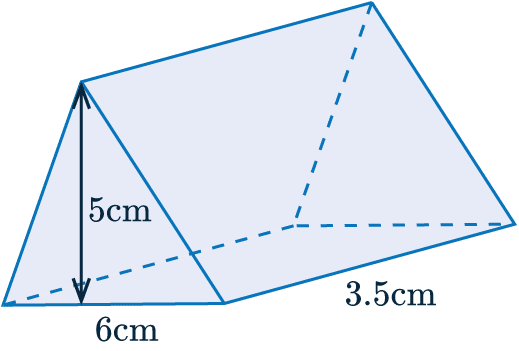
In this case, the cross section is a triangle, then nosotros demand to multiply the area of the triangle by the length. We get:
\text{Surface area of cross section }=\textcolor{cerise}{\dfrac{1}{ii}\times5\times half dozen}=\textcolor{red}{15}\text{ cm}^two
Therefore,
\text{Volume of the prism }=\textcolor{cerise}{15}\times \textcolor{blue}{3.five}=52.five\text{ cm}^iii.
Level iv-v GCSE
Volume of Pyramids and Cones
The formulas for the volume of pyramids and cones are:
\text{Volume of pyramid }=\dfrac{1}{3}\times\textcolor{scarlet}{\text{ expanse of base }}\times\textcolor{blueish}{\text{ perpendicular acme}}
\text{Book of cone }=\dfrac{1}{3} \times \textcolor{red}{\pi r^2} \times \textcolor{blue}{\text{ perpendicular height}}
Example: Below is a square-based pyramid.
The base of operations has side-length xiv mm and the pyramid has perpendicular height 25 mm.
Work out the volume of the pyramid.

For this question we have a square base of operations, and so we have to find one third of the area of the square times by the meridian.
We get:
\text{Area of base }= \textcolor{red}{14^2}= \textcolor{red}{196}\text{ mm}^2
Therefore,
\text{Volume of the pyramid }=\dfrac{1}{3} \times \textcolor{cherry-red}{196}\times\textcolor{blueish}{25}=1633.3 \text{ mm}^3
Level iv-v GCSE
Volume of a Sphere
The formula for the volume of a sphere is:
\text{Book of a sphere} = \dfrac{4}{3}\textcolor{red}{\pi} \textcolor{blueish}{r}^iii
Example: Below is a sphere with radius \textcolor{blueish}{4} cm
Summate the volume of the sphere.
Give your answer to 3 significant figures.
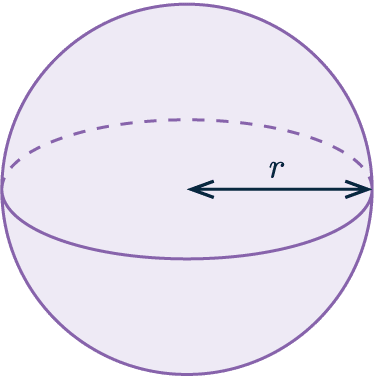
We know the radius of the sphere is 4 cm, so we need to input this into the formula.
Book of a sphere = \dfrac{4}{3} \textcolor{scarlet}{\pi} (\textcolor{blue}{four})^3 = 268 \text{ cm} ^three (3 sf)
Level 4-5 GCSE

Example: Composite Shape
The shape below was fabricated by attaching a cone to the top of a cylinder.
The base of the cylinder has radius iv mm, the superlative of the cylinder portion is 3 mm, and the height of the cone portion is 5.five mm.
Calculate the volume of the whole shape.
[4 marks]
And so, to work out the volume of the shape, we need to work out the two volumes separately.
Firstly, the cylinder is a type of prism, so we calculate the following:
\text{volume of cylinder}=\pi\times4^2\times3=48\pi
Next, nosotros have to work out the book of the cone:
The vertical height = 5.5 mm and the radius = iv mm.
Therefore, we get
\text{volume of cone }=\dfrac{1}{3}\pi\times4^2\times5.v=\dfrac{88}{three}\pi
Then, the volume of the shape is the sum of these two answers:
\text{book of whole shape }=48\pi+\dfrac{88}{3}\pi
= 242.9498...=242.nine\text{ mm}^3\text{ (1 dp)}
Level 4-five GCSE
Instance Questions
To detect the volume nosotros simply have to multiply all 3 lengths together:
\text{book}= 3\times12 \times16=576\text{cm}^3
The volume of a square base pyramid is given by the following formula:
\text{volume}= \dfrac{1}{3} \times \text{base area} \times \text{tiptop}
Substituting the values given in the question into the equation to a higher place, we find that,
\text{volume}= \dfrac{1}{iii} \times 5^{2} \times 12 =100 \text{yard}^3
So, to work out the volume of a prism nosotros must multiply the surface area of the cross section by the length. In this instance, the cantankerous department is a trapezium, and the area of the trapezium is:
\text{area of cantankerous department }=\dfrac{one}{2}\times(45+60)\times20= one,050\text{ cm}^2
The length of the prism is lxxx cm, so we go:
\text{book of prism }=one,050\times80=84,000\text{ cm}^three
This may seem a little different, merely information technology really comes up a lot.
Commencement, we must write the volume in terms of x. The volume of a pyramid is i tertiary of the area of the base times by the perpendicular height. We know the area of the base is 18\text{cm}^2, and the expression we're given for the top is 10+5, so the volume is
\dfrac{1}{three}\times18\times(x+five)=6(x+five)
Now, the question also gave us the volume: 54\text{cm}^3, so nosotros tin equate this value to the expression nosotros found higher up and voila, we have an equation:
six(10+5)=54
Now, nosotros solve this equation to observe 10. Commencement, separate both sides by 6 to get:
x+five=54\div6=ix
Then, subtracting v from both sides we get the reply to be:
x=9-v=4\text{cm}
We will work out the volume of the cylinder first, and then the hemisphere, and add together together the values.
A cylinder is a prism which ways that to find the volume, we must multiply the surface area of the round cross section by its length. The radius of the circle is two.3m and the length is 5.6m, then we get:
\text{book of cylinder }=\pi \times (2.3)^ii\times5.6 \approx 93.07 \text{yard}^iii
Annotation: Keep the full answer stored in the estimator for adding it to the other value at the end.
Next, we are given the formula for the book of a sphere, and then to find the volume of the hemisphere we volition utilise this formula and then half the result. The radius of the hemisphere is the same as that of the cylinder, two.iii, and then nosotros get:
\text{volume of hemisphere }=\dfrac{i}{ii}\times\left(\dfrac{four}{3}\pi\times(ii.iii)^3\right)\approx 25.48\text{thou}^3
Therefore, the full volume of the shape is:
93.0665...+25.4825...=119\text{ thousand}^three \text{ (3s.f.)}
Related Topics
Worksheet and Case Questions
Drill Questions
Source: https://mathsmadeeasy.co.uk/gcse-maths-revision/volume-of-3d-shapes-gcse-maths-revision-and-worksheets/
0 Response to "3d Geometry Solids Review Sheet Paper 1 Style Questions"
Post a Comment